Category: Technical guide and troubleshooting | Author: Kimiya Sanat Savalan Research and Development (R&D) Unit
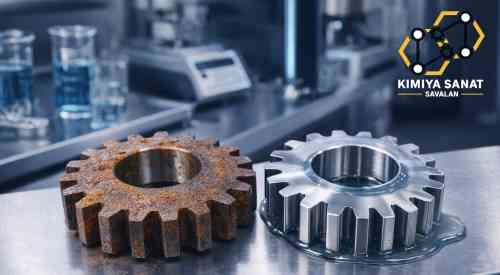
Water-based metalworking fluids provide temporary protection against oxidation and corrosion between production stages. Nevertheless, rust spots on machined parts and cast-iron machine slideways remain a common workshop problem.
Rust not only destroys the appearance of the final product and makes it unsalable, but also destroys the dimensional accuracy of the devices over time. In this article, we will examine the scientific reasons for this phenomenon and how to control it.
1. Fluid pH drop; fall into the acidic range
Water-based metalworking fluids are formulated to be alkaline to prevent corrosion of iron and steel. The ideal pH for these emulsions is between 8.88.88.8 to 9.59.59.5 is.
- The cause of rust: With the continuous operation of the fluid, water evaporation and especially the activity of bacteria, acidic compounds are produced in the tank and the pH decreases. When the pH is below 8.5 or 8.0 fall, the alkaline protective film is broken and the iron ions quickly react with the oxygen in the air to form iron oxide (red rust).
- the solution: Monitor the pH of the tank weekly with pH paper or digital pH meters. If the drop is severe, increase the concentration of the emulsion by adding fresh oil or use pH modifying solutions under the manufacturer’s supervision.
2. Using water with high chloride and sulfate
The quality of the water used to dilute the oil is as important as the oil itself.
- The cause of rust: The presence of chloride ions (Cl−) and sulfate (SO₄²⁻) in the process water can increase corrosion risk, particularly when using well water or mineral-rich mains water. Chloride ions can penetrate protective films and cause pitting even when the system pH is within its specified range.
- the solution:
- The amount of chloride used in the workshop water should be less than 100 ppm.
- If it is unavoidable to use unfavorable water, use lubricants with corrosion resistance and high hardness, such as
SVL-E200-HWIt is mandatory that they have a stronger inhibitor additive system (Corrosion Inhibitors).
3. Low emulsion concentration (over dilution)
Sometimes operators increase the water-to-oil ratio very high (e.g. 1 or 2% concentration) to save oil consumption.
- The cause of rust: At very low concentration, there may be too little corrosion inhibitor to protect the entire metal surface. Water then contacts exposed areas directly, increasing the risk of oxidation.
- the solution: Always monitor the concentration of the emulsion with a refractometer and adjust according to the technical recommendation of the lubricant manufacturer (usually at least 4% for steel parts).
4. Galvanic corrosion (contact of dissimilar metals)
Galvanic corrosion occurs in workshops that machine parts of different materials (such as aluminum, copper, cast iron, and steel) with a machine and a common water-miscible metalworking fluid tank.
- The cause of rust: When dissimilar metals are in electrical contact in the presence of a coolant electrolyte, their electrochemical potential difference can drive galvanic corrosion of the more active metal. Wet swarf accumulated on parts can also promote localised corrosion.
- the solution:
- Regularly clean the tanks and trays of the machine from metal swarf.
- Do not leave wet machined parts stacked on top of wet metal plates; Dry them and blow them with air.
5. Inadequate VCI protection in humid environments
In workshops where the relative humidity of the factory environment is very high, the rusting process accelerates.
- The cause of rust: After finishing the machining, the thin layer of emulsion is evaporated on the part. In areas with high humidity, moisture in the air condenses on the bare metal surface and causes localized rusting.
- the solution: Cover parts that need to be stored after leaving the machine with temporary protective oils or anti-corrosion papers (VCI).
Workshop rust prevention and troubleshooting checklist
content_copy
| Troubleshooting step | Parameter Measured | Target Condition | Corrective action in case of deviation |
|---|---|---|---|
| 1 | Emulsion pH measurement | 8.8−9.5 | Add fresh oil to correct pH or drain and rinse |
| 2 | Concentration measurement with refractometer | 4%−7% | Add a thick emulsion to compensate for the deficiency |
| 3 | Inlet water chloride analysis | <100 ppm | Use softened water or switch to a hard-water-stable fluid. |
| 4 | The state of cleaning the workshop | Free from Accumulated Swarf | Remove swarf from the sump and machine slideways every day. |
conclusion
Rust after machining often indicates an imbalance in coolant chemistry or unsuitable water or fluid quality. Routine concentration and pH checks, prompt swarf removal and an appropriate fluid grade can substantially reduce corrosion problems.
Specialists Kimiya Sanat Savalan They are ready to perform specialized corrosion tests (such as the Herbert test of cast iron swarf based on the IP-125 standard) on the current water-miscible metalworking fluid sample of your workshop to identify and fix the exact root of the corrosion problem.



No comment