
This post is also available in:
categorization: Technical and practical guide | the author: واحد Research and development (R&D) Kimia Sanat Savalan
Manually and visually measuring the concentration of metal working fluids (MWF) is one of the most costly mistakes made in lathe, CNC and rolling mills. The low or high concentration of the emulsion is a narrow border between “optimal tool performance” and “millions of damages due to rust, diamond burning, and waste of raw materials.”.
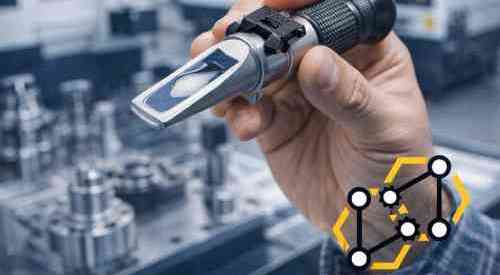
The most efficient and fastest tool for measuring the concentration of water-miscible metalworking fluid in the workshop، Optical refractometer device (Refractometer) is But what is the correct way to use this tool and why is the percentage read on the device usually different from the actual concentration of the emulsion?
1. Why is it so important to control the concentration of water-miscible metalworking fluid?
The performance of the metalworking fluid is completely dependent on its mixing percentage with water. Deviation from the standard concentration creates two dangerous scenarios:
a) Consequences of very low concentration (less than 3%):
- Fast rusting and corrosion: Reducing the dose of corrosion and rust inhibitors on the part and rail of the machine.
- Reduced tool life: Severe wear of the chipping tool due to insufficient supply of lubricating film.
- Rapid growth of bacteria: Weakening of the concentration of biocides and premature spoilage of the liquid.
b) Consequences of very high concentration (above 8% to 10%):
- Huge financial loss: Excessive and unnecessary consumption of oil.
- Reduction of cooling properties: Due to the high concentration of oil and the lowering of the heat capacity of the liquid.
- Creating annoying foam and adhesion: Remaining adhesive layers on the piece and making the tool hot.
- skin problems: Cause dermatitis and skin allergies for the device operator.
2. How does a refractometer work?
A manual refractometer is an instrument based on Law of refraction of light (Refraction) it works When the light passes through the liquid phase (emulsion), its angle of refraction changes according to the amount of solids and oil droplets dissolved in the water. This deviation on the graduated scale of the device (usually in Brix) is displayed.
3. The big secret: What is the “refractometer correction factor” (Refractometer Factor)?
The biggest workshop error is that the number read on the refractometer eyepiece (eg 4) is assumed directly as “concentration percentage of 4%”!
Technical truth: degree Brix represents total light refraction, not the actual weight percentage of the oil. Each formulation and oil base (mineral base, semi-synthetic, synthetic or vegetable oil) has its own refractive index to which Correction factor (Multiplying Factor) they say.
Calculation formula of actual concentration:
درصد غلظت واقعی (%)=عدد خواندهشده روی رفراکتومتر (Brix)×ضریب تصحیح روغن (Factor)
Practical example:
Suppose from the product SVL FLUID E100 You use a correction factor equal to 1.01.01.0 is If refractometer no Show 4, your concentration exactly It is 4% (4×1.0=4%).
But if from a semi-synthetic product or special base with a correction factor 1.51.51.5 Use and refractometer number 4 show, your actual concentration is equal 6%6\%6% will be (4×1.5=6%)! Ignoring this coefficient will make you misdiagnose the concentration of the liquid.
4. Step-by-step instructions for calibration and measurement in the workshop
Follow the steps below daily or weekly to get an accurate number:
- Charter cleaning: Wipe the glass prism and the clear cover of the refractometer with a soft, lint-free cloth.
- Calibration with distilled water (zero point): Put 1-2 drops of distilled water or pure water on the prism, close the cap and look in front of the light. The blue/white dividing line should be exactly on the number 000 be Otherwise, turn the adjustment screw on the top of the device to calibrate to zero.
- Correct sampling: Take the sample directly from the spray nozzle (in operation), not from the stagnant surface of the tank where suspended oils float..
- Number reading: Pour 1 or 2 drops of the emulsion on the prism and read the border line number.
- Apply the correction factor: Multiply the number read by the factor listed on the TDS sheet of the product.
5. Suggested concentration table for all types of machining operations
content_copy
| Type of operation | Suggested actual concentration range (%) | Technical considerations |
|---|---|---|
| Light grinding and chipping | 2.5%−4.0% | The need for maximum cooling and chip washing |
| General turning and milling | 4.0%−6.0% | Balance between lubrication and cooling |
| Nailing, deep drilling and heavy duty chipping | 6.0%−9.0% | The need for strength of the lubricating film and high pressure resistance |
| Cold rolling of pipes and profiles | 3.0%−5.0% | Stability in high flow circulation and stain control |
conclusion
Refractometer is a simple but very powerful tool for quality control of metalworking fluid. By allocating only 3 minutes a day to monitor the concentration and multiply the number Standard correction coefficient of Savalan lubricants، You can dramatically increase the life of your emulsion and tools and reduce production line operating costs.
Technical support team Kimia Sanat Savalan، Provides accurate correction factor for all SVL series grades in Technical Data Sheets (TDS) and is ready to calibrate and train measuring instruments at your factory site..



No comment